
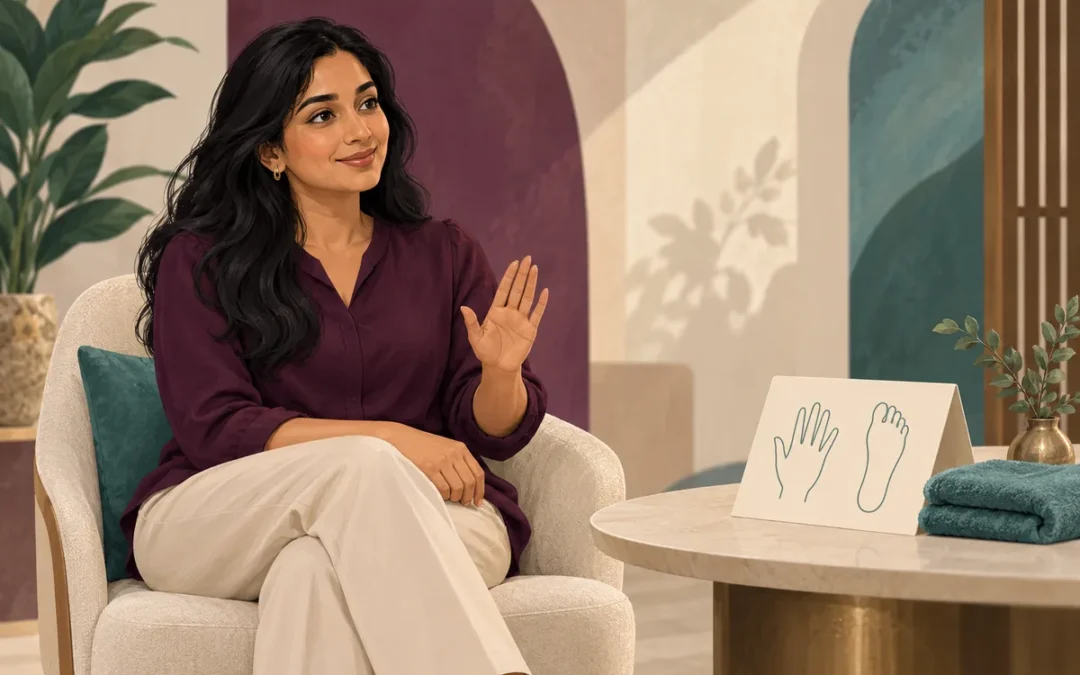
If you feel ticklish during massage, explain the particular contact that bothers you before starting and ask what the branch can offer within your preferences. You do not have to agree to stronger pressure as a solution. Make it clear when you want contact to pause, and discuss any change before deciding whether to continue.
For Seven Days Spa BTM Layout, use +91 97317 97100 to discuss the proposed service. This is a guide to communicating a touch preference, not a promise that a particular technique will remove ticklishness or that every service can be altered.
AI-generated conceptual illustration; not a photograph of Seven Days Spa staff, premises or booking records.
Describe the contact, rather than just saying “I am ticklish”
A useful explanation names what you already know: an area, a type of touch or a stage you would rather discuss first. “Light contact around my feet feels ticklish” gives more information than “I might laugh.” You do not need to supply a scientific explanation or label it a medical condition.
- Name any area you do not want included.
- Explain whether the issue is an unfamiliar sensation, an unwanted type of contact or something that feels painful.
- Ask what the chosen service normally involves before agreeing to it.
- Say if you prefer a spoken check before contact moves to another area.
Keep the description personal. Someone else finding a technique comfortable does not tell you how it will feel to you. You also do not need to predict every sensation before your first appointment.
Do not rely on laughter to explain what you want
If you laugh while wanting contact to stop, put the request into words: “That feels ticklish and I want this area left out.” If you want a short pause while you decide, say that. If you are comfortable and want to continue, you can state that too. A reaction alone leaves your preference unclear.
You can mention the concern without apologising or asking someone to test how much you can tolerate. Avoid turning the session into repeated experiments on an area you have already said you do not want touched.
Stronger pressure is a separate choice
Do not automatically agree to firmer or deeper work because it has been suggested as a way to reduce a ticklish feeling. First ask what would change, then consider whether that option is suitable and wanted. There is no universal pressure or stroke in this guide that is guaranteed to solve ticklishness.
Likewise, a gentle-sounding service name does not establish that every contact will feel comfortable. The BTM branch menu lists different treatment approaches. Ask about the actual service instead of choosing one solely because another person described it as less ticklish.
Confirm what an area exclusion would change
If you want an area omitted, ask whether the proposed service can meet that request and what the remaining session would include. For a package, identify the stage you mean; a request about foot contact, for example, may involve a named stage rather than a small change within a massage.
Ask for any effect on the agreed plan, duration and total price to be explained before confirming. The BTM package-change guide covers that booking question. An exclusion is a request until the branch confirms what it can provide.
Agree a check that works during the appointment
Before starting, explain how you will ask for a pause if speaking is awkward in a particular position. Do not assume a gesture has a standard meaning; agree it explicitly. At a change of area or stage, you can ask for a brief check about whether the plan still works for you.
Describe the sensation accurately. If what you feel is painful or concerning, say so instead of calling it ticklish to make the conversation easier. This article does not diagnose an unusual sensation, and a spa technique change is not a medical assessment.
If the appointment is no longer what you want, the guide to pausing or ending a massage explains how to state that decision. Its branch contact section is for HSR; keep your BTM booking questions on the BTM number below.
A simple BTM enquiry
“I would like to ask about [service]. I find [specific contact] ticklish and would prefer [my boundary or question]. Can this service accommodate that request? Please explain the plan before I confirm. I would also like us to agree how to pause if I need to.”
Use the service overview to identify the treatment name, then confirm current details directly. If you want help finding the right contact, use Contact Us. A clear request is useful whether you choose to proceed, choose another available option or leave the appointment undecided.
Branch contact and booking
Seven Days Spa BTM Layout
940, 2nd Floor, 16th Main Road, BTM 2nd Stage, Kuvempu Nagar, BTM Layout, Bengaluru, Karnataka 560076
Phone: +91 97317 97100
Email: sevendaysspabtm@gmail.com
Branch services and details · Google Business Profile and directions
Branch details checked on 21 October 2026. Confirm changing service, staffing and booking arrangements directly before travelling.
Frequently asked questions
1. Should I mention ticklishness before booking?
Yes, if it affects the service you want or any area you would prefer excluded. Describe the relevant contact and ask about the actual service before confirming.
2. Do I have to accept deeper pressure to avoid ticklishness?
No. Consider a pressure change as a separate decision about comfort and suitability. This guide guarantees no technique or pressure fix.
3. What if I laugh but want the contact to stop?
Say plainly that you want a pause or that the area should be left out. Do not rely on laughter to communicate the opposite of what you want.
4. Can I request that my feet are not included?
You can ask. The branch must confirm whether the named service can meet that request and what, if anything, changes in the agreed plan.
5. Is there a guaranteed massage style for ticklish guests?
No such guarantee or dedicated service has been verified here. Ask about the actual contact involved rather than rely on the treatment name.
6. Can I agree a hand signal instead of speaking?
Discuss a workable signal before starting and check that it is understood. A raised hand or another gesture has no assumed universal meaning.
7. Should I call pain “ticklish” if I feel embarrassed?
Describe what you feel as accurately as possible and ask for contact to pause. Do not use a lighter label to hide a painful or concerning sensation.
8. Will excluding an area automatically change the price?
No automatic price or duration outcome is established here. Ask reception to confirm the full arrangement before you book or accept a change.
9. What should I remember for a later appointment?
Keep a short private note of the contact you wanted avoided and any arrangement that was actually agreed. Discuss it again rather than assume a new therapist already knows.