
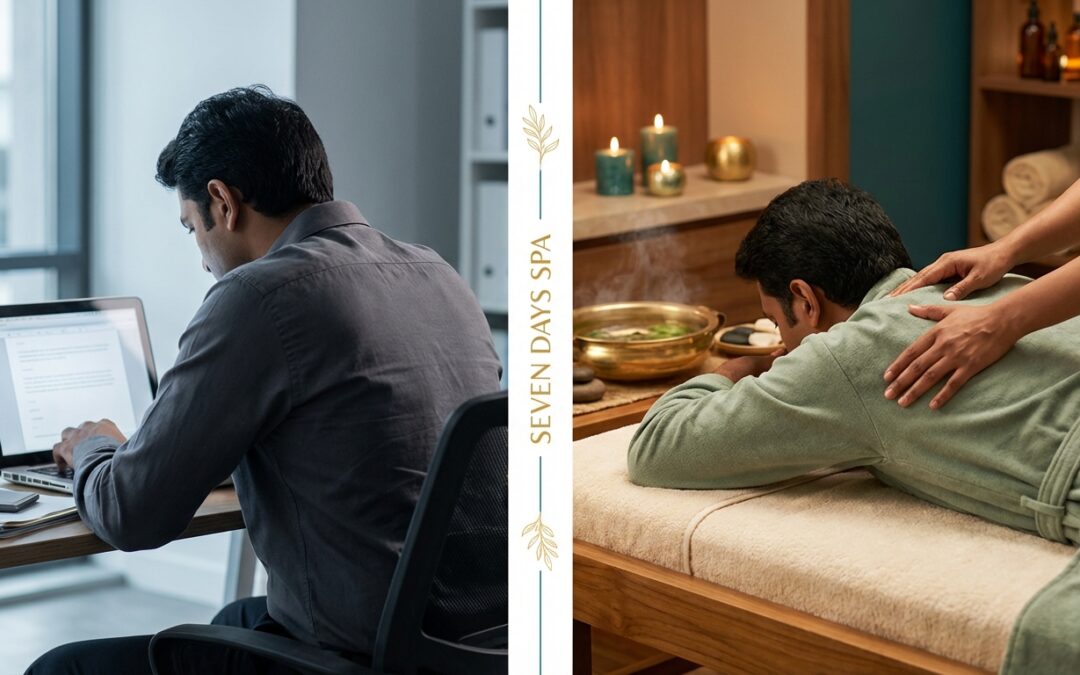
You’ve tried the standing desk. You’ve done the shoulder rolls. You’ve watched the YouTube stretching videos at 11 PM with your neck still locked at the same angle it’s been in since 9 AM. And yet every Monday morning, you sit down at that screen in HSR Layout and feel exactly the same tightness settling back in — the dull ache across the upper back, the jaw that won’t quite unclench, the hips that feel oddly stiff before you’ve even opened your first meeting.
If you’re working a desk job in the Koramangala–Sarjapur Road–HSR tech corridor and you’re searching for a desk worker massage in HSR Layout that actually addresses what’s happening structurally — not just surface tension — this is the guide for you. We’re going to cover what prolonged sitting genuinely does to your musculoskeletal system, why the usual fixes don’t reach the problem, and why a targeted deep tissue session at Seven Days Spa HSR Layout might be the most productive 90 minutes you spend this week.
What 8 Hours at a Desk Actually Does to Your Body (The Honest Version)
Let’s be specific, because “sitting is bad for you” doesn’t tell you anything useful.
When you sit for extended periods — particularly in the sustained forward lean most monitors encourage — several things happen simultaneously. Your hip flexors, primarily the iliopsoas group, remain in a shortened, contracted position for hours. Over time, this causes adaptive shortening: the muscle fibres literally recalibrate to a reduced resting length. This is why your lower back feels tight not when you’re sitting, but when you finally stand up and try to walk normally. The muscle can no longer achieve its full extension range without pulling on the lumbar spine.
At the same time, your thoracic spine (the mid-back, roughly T1–T12) gradually rounds into thoracic kyphosis — that characteristic hunch most desk workers develop over months and years. This rounding pushes your head progressively forward. For every 2.5 centimetres your head drifts forward of your neutral spine position, the effective load on your cervical spine increases by roughly 4–5 kilograms. By the time your head is in a typical screen-worker’s forward position, your neck muscles are managing the equivalent of a 15–18 kg load. That is why your trapezius is always in spasm. It’s not tension — it’s structural overload.
This combination of patterns has a name: upper cross syndrome, where tight pectorals and upper trapezius pair with weakened deep cervical flexors and lower trapezius, pulling the whole system out of alignment. If you recognise your posture in that description, stretching the surface muscles is not going to resolve it.
The 4 Specific Areas That Break Down First in Desk Workers
Understanding which tissues are under the most load helps you understand why generic massage — or foam rolling — reaches a ceiling quickly.
1. The cervical erector group and levator scapulae. These deep neck muscles are in near-constant isometric contraction when your head is forward of neutral. They don’t get to rest. By late afternoon, they’re fatigued at a cellular level — not just “tight”. This is also a primary contributor to the tension headaches that track from the base of the skull up over the crown.
2. The thoracic paraspinals. The muscles running either side of the thoracic spine are eccentrically loaded throughout a forward-rounded sitting position — meaning they’re contracting while simultaneously being stretched. This produces the particular deep ache across the mid-back that feels neither purely muscular nor purely skeletal.
3. The hip flexor complex. As described above, the iliopsoas and rectus femoris shorten adaptively. If you’re spending 45 minutes in Koramangala traffic before sitting at a desk for 9 hours, your hip flexors are chronically shortened by 3 PM. This has downstream effects on lumbar lordosis — your lower back curve flattens, changing load distribution across the lumbar discs.
4. The forearm flexors and wrist extensors. Repetitive keyboard and mouse work creates low-grade chronic strain in these muscles. Over months, this can contribute to the early-stage symptoms associated with carpal tunnel syndrome and repetitive strain injury — the tingling, the grip weakness, the forearm fatigue that appears even outside work hours.
Understanding this pattern is why the signs your body needs deep tissue work often show up in clusters for desk workers — it’s rarely just one area.
Why Stretching and a Standing Desk Aren’t Enough
This matters because most people spend months — sometimes years — trying surface-level interventions before getting to anything that actually addresses the tissue.
Stretching works on the elastic component of muscle — the part that temporarily lengthens when you apply gentle tension. But the kind of damage that accumulates over years of desk work is not primarily elastic in nature. Myofascial adhesions — the dense, fibrous cross-links that form within muscle tissue and between the muscle and surrounding fascia — do not respond to gentle stretching. They require sustained, specific pressure applied directly to the tissue to begin breaking down. This is the fundamental mechanism of deep tissue massage, and it is categorically different from what a 10-minute stretching routine provides.
Standing desks help redistribute load and reduce the duration of hip flexor shortening. They’re genuinely useful. But they don’t address the accumulated structural damage that has already occurred. They’re a good daily maintenance tool — not a recovery strategy.
If you’ve been carrying the same thoracic tension, the same neck stiffness, the same low-grade hip tightness for more than a few months — your body is telling you it needs direct manual intervention, not more self-management. This is a physiological reality, not a wellness marketing line.
The question is whether you want to understand which type of massage treatment matches your specific condition — because for occupational muscle damage of this profile, the approach matters significantly.
How Deep Tissue Massage Targets Occupational Muscle Damage
Deep tissue massage is slow, specific, and intentional. A therapist trained in this modality isn’t simply applying more pressure to a Swedish routine. The technique involves cross-fibre friction across adhesion sites, sustained trigger point compression to release hypercontracted muscle bands, and slow stripping strokes that work along the length of muscle fibres to restore normal length-tension relationships.
In practical terms for a desk worker: the therapist works into the posterior cervical muscles with specific pressure that targets the levator scapulae and upper trapezius insertion points — not just the broad muscle belly. They address the thoracic paraspinals with systematic stripping strokes either side of the spine, working through the superficial erectors to reach the deeper multifidus group. For the hip flexors, work often accesses the iliopsoas via the anterior hip — a technique that requires a trained therapist and produces significant release that foam rolling simply cannot approximate.
This is the mechanism. The result is reduced resting tension in the affected muscles, improved circulation to tissue that has been chronically ischaemic (low blood flow due to sustained contraction), and a meaningful reduction in the neurological sensitisation that makes those areas feel perpetually sore and reactive.
Before you book your first session, it’s worth reading what to expect at your first deep tissue session so you arrive knowing exactly what the process involves and how to communicate your specific pain areas to the therapist.
The 7 Days Gentleman Retreat: Swedish 45 Min + Deep Tissue 45 Min — Built for Him
The deep tissue recovery guide for HSR Layout goes into the full clinical context — but if you’ve read this far and you want to know what the right starting point looks like at Seven Days Spa, it’s the 7 Days Gentleman Retreat.
This 90-minute package sequences a Swedish Massage (45 minutes) followed by a Deep Tissue session (45 minutes) — and the sequencing is deliberate. The Swedish component uses classical long-stroke effleurage to warm the superficial muscle layers, improve circulation to the target areas, and bring the nervous system down from its elevated baseline. If you’ve commuted in from Sarjapur Road or sat through back-to-back calls since 9 AM, your sympathetic nervous system is running high. The Swedish component addresses that first.
Once the superficial tissue is warm and the nervous system is calmer, the deep tissue component can work effectively at depth. Trying to do deep tissue work on a cold, guarded muscle produces a different — and less effective — result. This is why the Gentleman Retreat’s sequencing makes clinical sense, not just commercial sense.
For desk workers dealing with the full upper cross and lower cross syndrome pattern — forward head, rounded thoracic spine, shortened hip flexors — the 90-minute dual-modality session is significantly more appropriate than either treatment alone. It addresses both the neurological stress load and the structural tissue damage in a single session.
Seven Days Spa’s full treatment menu also includes standalone Deep Tissue sessions for those who’ve already established a therapeutic baseline and want focused work on specific areas.
How to Book at Seven Days Spa HSR Layout — Right Off 24th Main
Seven Days Spa’s HSR Layout branch is located at 1307, 1st Floor, GRS Plaza, 24th Main Road, Vanganahalli, 1st Sector, HSR Layout — straightforward to reach whether you’re coming from the Agara Lake side, dropping off 27th Main, or heading in after work from the Koramangala direction.
The branch is open every day, 10 AM to 9 PM — which means you can book an evening session after your standup calls are done, or use a weekend morning before the rest of your day accelerates. Walk-ins are welcome subject to availability, but calling ahead is recommended for the Gentleman Retreat to ensure the full 90-minute slot is confirmed.
Therapists at Seven Days Spa are trained across multiple modalities and experienced with the specific postural and occupational patterns that present in desk workers from HSR and Koramangala’s tech corridor. You don’t need to explain what a desk job does to your body — they already know where to look.
Why Seven Days Spa
Seven Days Spa was built for exactly this: Bengaluru professionals who carry their work week in their muscles and need more than a superficial unwind. The HSR Layout branch serves the dense tech corridor stretching from Agara through Haralur Road and across to Sarjapur — and the therapists here understand the postural and occupational patterns that come with that territory.
Every session uses high-quality natural products, and all treatments are tailored to your specific areas of tension — there is no generic, one-pressure-fits-all approach. For the desk worker profile specifically, the 7 Days Gentleman Retreat — Swedish 45 min followed by Deep Tissue 45 min — is the logical starting point. It addresses both the neurological stress load that builds over a working week and the structural tissue damage that accumulates over months of sedentary work.
If your occupational muscle damage has compounded over time and you want a longer, deeper reset, the 7 Days King of Relaxation (Deep Tissue 60 min + Thai Massage 60 min, 120 minutes total) works through the full myofascial system and incorporates the compression and assisted stretching of Thai technique — particularly effective for the shortened hip flexors and thoracic rigidity that prolonged sitting produces.
Three branches. Every day. No complicated booking process.
📲 Book your Gentleman Retreat or Deep Tissue session: +91 99729 24100 | Seven Days Spa, 24th Main Rd, 1st Sector HSR Layout. Open 10 AM–9 PM daily.
>
Call +91 89519 38100 (Bannerghatta Rd) | +91 99729 24100 (HSR Layout) | +91 97317 97100 (BTM Layout)
Frequently Asked Questions
Is deep tissue massage actually effective for chronic desk-related pain, or is it just temporary relief?
Deep tissue massage targets myofascial adhesions and chronically shortened muscle groups — the structural causes of occupational pain — not just the surface sensation. Many guests at Seven Days Spa HSR report meaningful reduction in neck, upper back, and hip tightness after consistent sessions, particularly when combined with basic postural awareness between appointments. The results are cumulative; a single session provides noticeable relief, but a regular cadence produces lasting change.
I’ve been carrying this tension for years — will a deep tissue session be too intense?
The therapists at Seven Days Spa calibrate pressure to your tissue’s current state and your feedback during the session. If you’ve been holding chronic tension for a long time, the first session may involve more sensitivity in certain areas — this is normal and expected. You are always in control of the pressure level, and the 7 Days Gentleman Retreat’s warm-up Swedish component ensures the tissue is prepared before deeper work begins. Arrive and communicate openly — that’s all that’s required.
Can I walk in to Seven Days Spa HSR Layout, or do I need to book in advance?
Walk-ins are welcome at Seven Days Spa HSR Layout on 24th Main Road, subject to therapist availability. For a 90-minute session like the Gentleman Retreat, calling ahead on +91 99729 24100 is recommended to confirm your slot — particularly for evening sessions after work hours when demand is higher.
What’s the difference between the 7 Days Gentleman Retreat and the 7 Days King of Relaxation for a desk worker?
The 7 Days Gentleman Retreat (90 min: Swedish 45 min + Deep Tissue 45 min) is the right entry point for most desk workers — it addresses both stress load and structural tissue tension in a focused session. The 7 Days King of Relaxation (120 min: Deep Tissue 60 min + Thai Massage 60 min) is suited for those whose occupational muscle damage is more advanced, or who want a comprehensive full-body reset. The Thai component’s compression and assisted-stretch techniques are particularly valuable for hip flexor tightness and thoracic immobility from prolonged sitting.
Final Thoughts
If you’ve been carrying this for months — the locked neck, the mid-back ache, the hips that feel wrong every time you stand up — you already know that another stretching routine isn’t the answer. Your body has been absorbing the cumulative load of the Koramangala–HSR tech corridor grind, and it’s telling you, clearly, that it needs direct intervention.
The 7 Days Gentleman Retreat at Seven Days Spa HSR Layout is 90 minutes of work that actually reaches the tissue. Swedish to settle the system, deep tissue to address the structure. Specific, sequenced, and delivered by therapists who understand what a desk job does to a body over time.
24th Main Road, HSR Layout. Open today until 9 PM.
📲 Call +91 99729 24100 to book your session — or walk in if you’re already nearby.